Invest in Armenia’s Talent – Help Us Provide World-Class Education at No Cost to Locals. Donate here.
The Science Behind BuildUp’s Methodology

Lilit Andriasian
Sep 19, 2022 - 5 min read
Remember the last time you went for a health checkup? It probably looked something like this: the doctor asked you about your symptoms and sent you for some medical tests. Using the results, your doctor was able to make more precise decisions on his next steps — either send you to another professional, prescribe medications that went through clinical trials and proved their effectiveness, or say “you are healthy, hope I won’t need to see you again soon.” This is called evidence-based medicine, which began to establish itself in the 18th century and became the gold standard for medical care in the 20th century. Luckily for us, doctors make decisions based on real data, have professional standards and algorithms, and use all of their accumulated scientific knowledge to cure patients.
Now, remember yourself at school, university, or another professional training course. In those experiences, how many times were you sure your teacher was “prescribing” you effective education, as well as testing and analyzing your progress, not just grading you? How often were teachers using knowledge in cognitive science, pedagogy, and psychology to support your learning? The recent trend that we are happy to be part of is evidence-based education. As more and more scientific papers and non-fiction books are asking how we can teach and learn better, we now have a basis for rationally constructing educational programs leading to more effective development.
At BuildUp, we “prescribe” experiential learning to students, which is also often called “learning by doing” (Kolb, 2015). Experiential learning made a breakthrough in the science of learning because it:
- Shifted the perception of the learning process from a behavioristic approach that was not very human-centered to a human-oriented one, which endowed a person with agency.
- Helped scholars and educators perceive learning as more process-oriented rather than outcome-oriented, focusing on the prior experience a student brings to the learning environment and the emotions that influence learning.
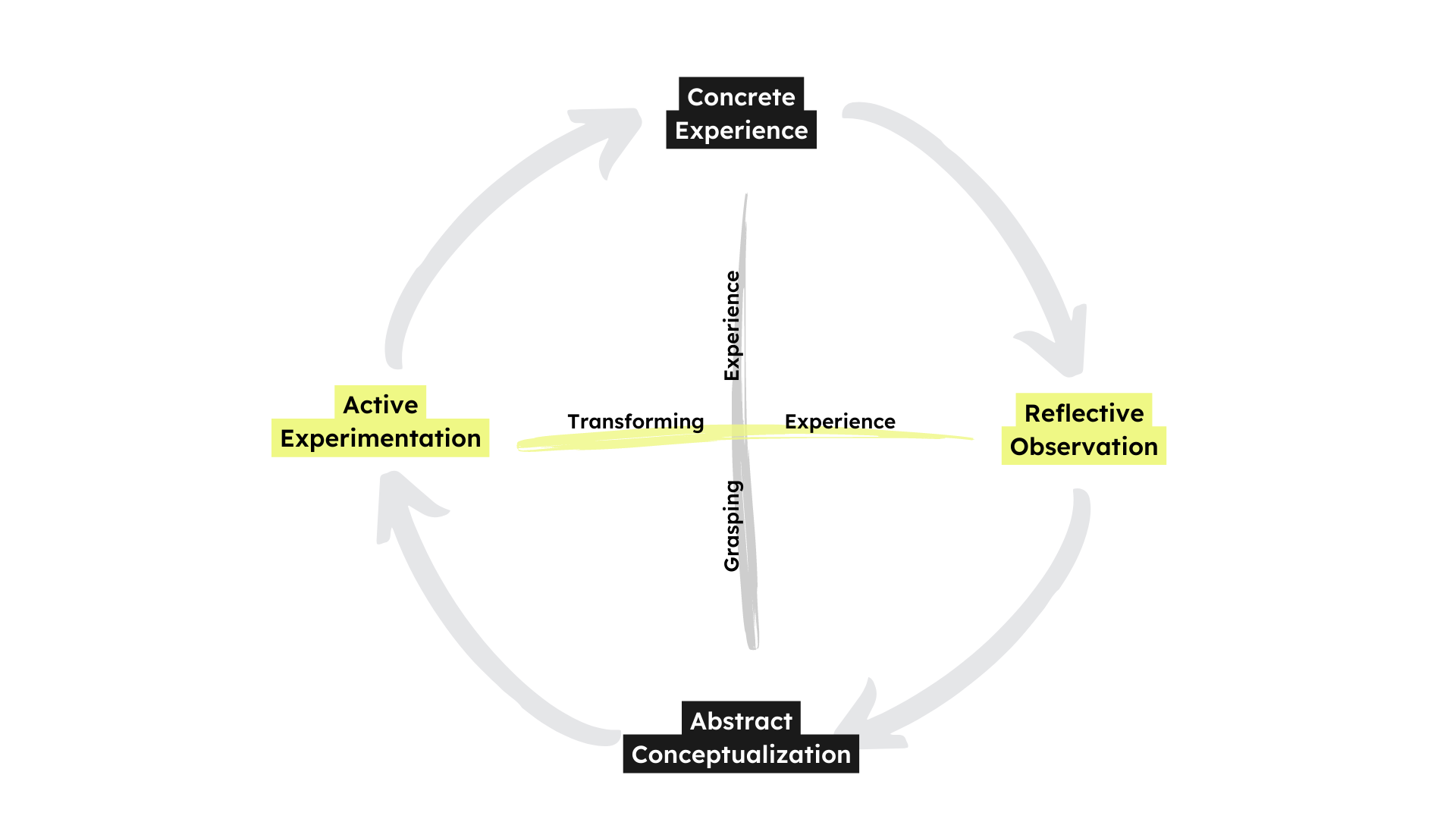
Here is David Kolb’s Learning Cycle, explaining the stages of experiential learning (picture 1). At BuildUp, we are creating a safe environment that prompts learners to go faster during that cycle, gaining many new experiences, conceptualizing them, and reflecting on them:
Picture 1. David Kolb’s Learning Cycle (Kolb, 2015)
In addition to the conceptual framework of experiential learning, here are some more scientifically-proven approaches that we are using at BuildUp Bootcamp:
- Problem-Based Learning (PBL). This is a student-centric approach that puts emphasis on solving open-ended problems and learning from that experience. The reality of the tasks faced by students stimulates them to cognition and supports their inner motivation (Barrows, 1996). It leads to constructing more complex skills (Gan et al., 2020; van Merriënboer, 2007), as solving a problem requires multidisciplinary knowledge and a high level of critical thinking. There is a body of research that shows how PBL makes learning more effective (De Witte & Rogge, 2016) and (even if it does not directly impact effectiveness) is more appreciated by students (Dyke et al., 2001).
- Cooperative Learning. This approach involves students working together to achieve common goals or complete group tasks: goals and tasks they would be unable to complete by themselves. The studies show that cooperation is more effective than interpersonal competition and individualistic efforts — and that intergroup competition is also superior to interpersonal competition and individualistic effort (Gillies, 2016).
- Growth Mindset. This is a person's belief that intelligence can be developed through the learning process. With a growth mindset, individuals tend to embrace challenges, persevere in the face of adversity, accept, and learn from failure, and focus on the process rather than the outcome (Bates B., 2016). Research shows that a growth mindset can be passed on to students (Yeager et al., 2019), and that’s what we do at BuildUp!
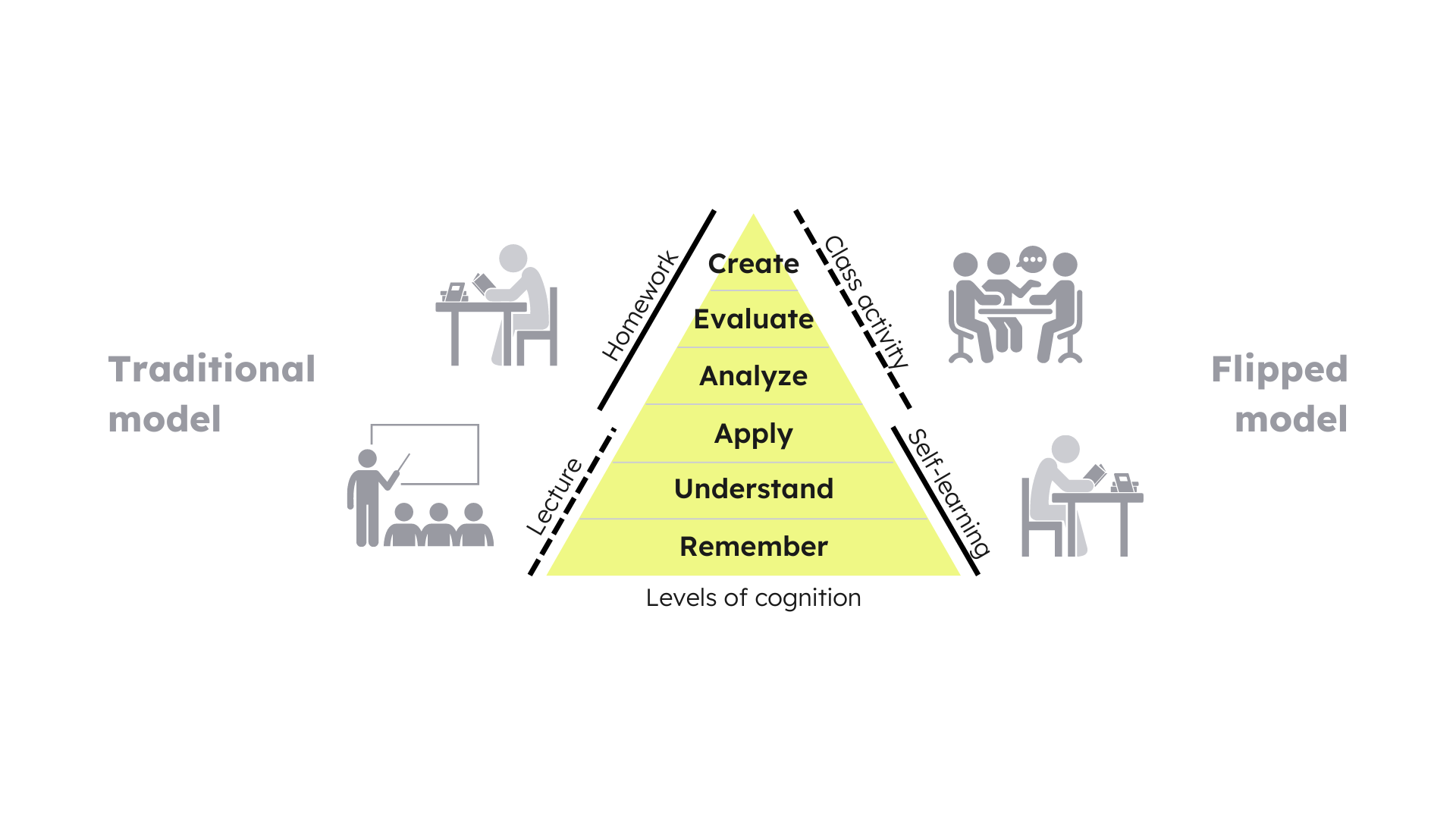
- Flipped Classroom. This is a model of teaching where the introduction of new theoretical material to students takes place at home, and “classroom” time is allocated for the performance of tasks, exercises, laboratory or practical research, and individual consultations with the teacher. The results show that if a flipped classroom is used properly with cooperative learning, student scores are significantly higher for the flipped classroom group than for the control group (receiving traditional lectures) (Foldnes, 2016). Moreover, flipped classrooms promote self-regulated learning (Lai & Hwang, 2016) and higher levels of engagement (Gilboy et al., 2015).
Picture 2. Flipped Classroom presented on Bloom’s Taxonomy
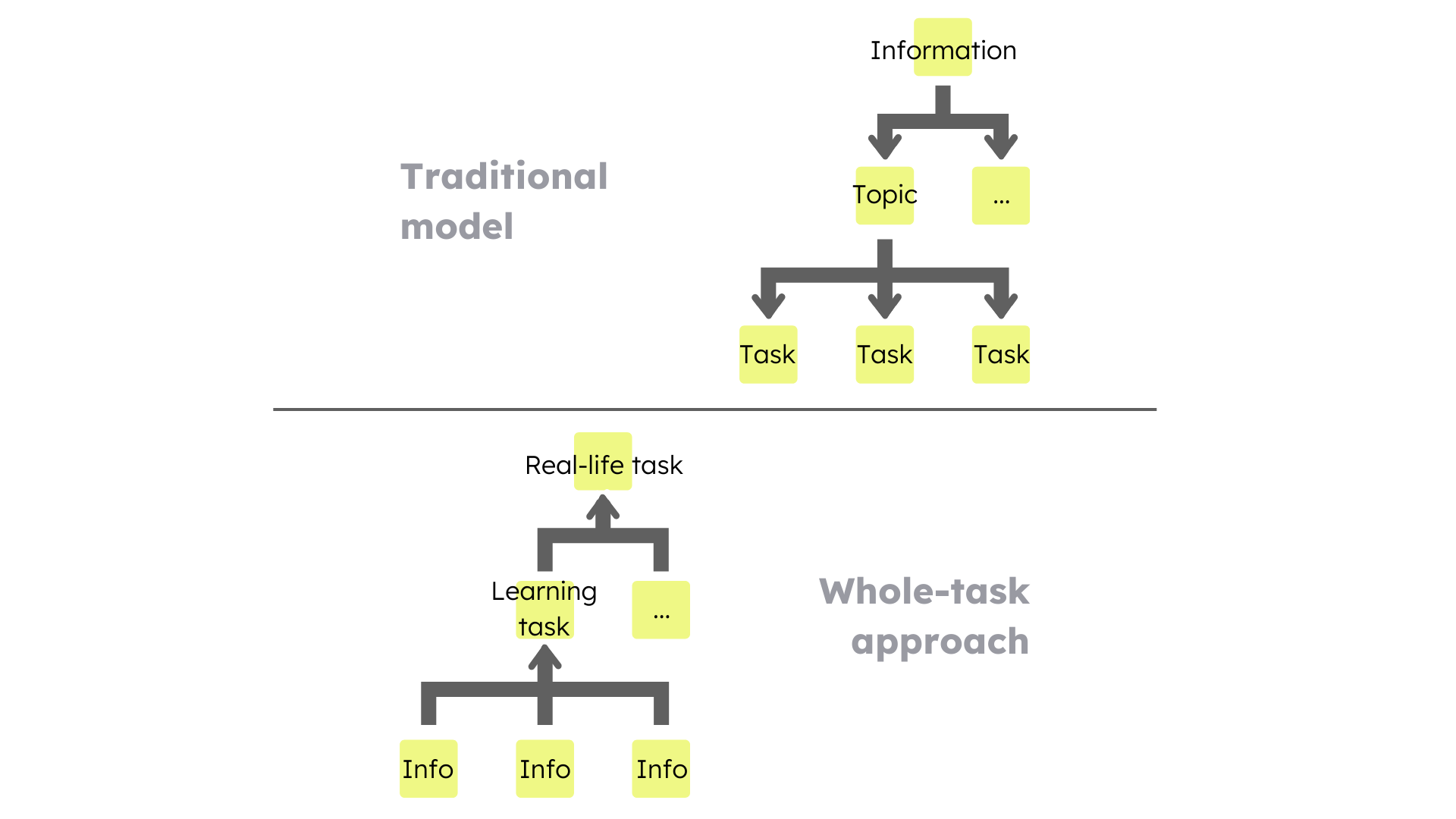
- Whole Task Approach. In traditional education, we divide information into smaller topics, create tasks for each topic, and assume that students can use whole knowledge if they pass all the tests. It doesn’t always work this way. Research shows that it can be more effective to integrate the complex, real-life tasks that professionals face. Instructors can then use these real-life tasks to create learning opportunities, and only after that present supportive information, as students will then understand its value for solving the problem (Merriënboer & Education, 2007).
Picture 3. Visualization of the difference in a Whole Task Approach
- Feedback for Formative Assessment. In traditional learning, students mostly get feedback on tasks that are “high stack,” meaning if you do not pass them well, you will experience challenges going forward. But the best learning happens when we receive feedback not only on the exam or final essay but during the execution of tasks when failure happens. As teachers, we can create a lot of moments to provide students interim feedback, which can lead to them changing their strategies and trying new ideas (Bennett, 2009).
Stay tuned and support us to see even more evidence-based educational methods — and better tech learning — implemented in BuildUp Bootcamp.
References
Barrows, H. S. (1996). Problem-based learning in medicine and beyond: A brief overview. New Directions for Teaching and Learning, 1996(68), 3–12. https://doi.org/10.1002/tl.37219966804
Bates B. (2016). Learning theories simplified : 100 theories and models from great thinkers...and how to apply them to teaching. SAGE Publications.
Bennett, R. E. (2009). A critical look at the meaning and basis of formative assessment. Princeton, NJ: Educational Testing Service.
De Witte, K., & Rogge, N. (2016). Problem-based learning in secondary education: evaluation by an experiment. Education Economics, 24(1), 58–82. https://doi.org/10.1080/09645292.2014.966061
Dyke, P., Jamrozik, K., & Plant, A. J. (2001). A randomized trial of a problem-based learning approach for teaching epidemiology. Academic Medicine, 76(4), 373–379. https://doi.org/10.1097/00001888-200104000-00016
Foldnes, N. (2016). The flipped classroom and cooperative learning: Evidence from a randomized experiment. Active Learning in Higher Education, 17(1), 39–49. https://doi.org/10.1177/1469787415616726
Gan, B., Zhang, C., Wang, R., & Deng, F. (2020). Research on the Design and Application of complex skill Learning based on TPACK Theory and 4C/ID Model. Proceedings - 2020 International Conference on Computer Engineering and Application, ICCEA 2020, 699–702. https://doi.org/10.1109/ICCEA50009.2020.00152
Gilboy, M. B., Heinerichs, S., & Pazzaglia, G. (2015). Enhancing student engagement using the flipped classroom. Journal of Nutrition Education and Behavior, 47(1), 109–114. https://doi.org/10.1016/j.jneb.2014.08.008
Gillies, R. M. (2016). Cooperative learning: Review of research and practice. Australian Journal of Teacher Education, 41(3), 39–54. https://doi.org/10.14221/ajte.2016v41n3.3
Kolb, D. A. (2015). Experiential learning : experience as the source of learning and development.
Lai, C. L., & Hwang, G. J. (2016). A self-regulated flipped classroom approach to improving students’ learning performance in a mathematics course. Computers and Education, 100, 126–140. https://doi.org/10.1016/j.compedu.2016.05.006
Merriënboer, J. J. G. van, & Education, L. K. S. E.-W.-T. M. in. (2007). Whole-Task Models in Education. In Handbook of Research on Educational Communications and Technology. Routledge. https://doi.org/10.4324/9780203880869.ch35
Merriënboer, J. J. G. (2007). Ten Steps to Complex Learning. In Ten Steps to Complex Learning. https://doi.org/10.4324/9781410618054
Yeager, D. S., Hanselman, P., Walton, G. M., Murray, J. S., Crosnoe, R., Muller, C., Tipton, E., Schneider, B., Hulleman, C. S., Hinojosa, C. P., Paunesku, D., Romero, C., Flint, K., Roberts, A., Trott, J., Iachan, R., Buontempo, J., Yang, S. M., Carvalho, C. M., Dweck, C. S. (2019). A national experiment reveals where a growth mindset improves achievement. Nature, 573(7774), 364–369. https://doi.org/10.1038/s41586-019-1466-y
Become a student
Download "Pathfinder Agent"
